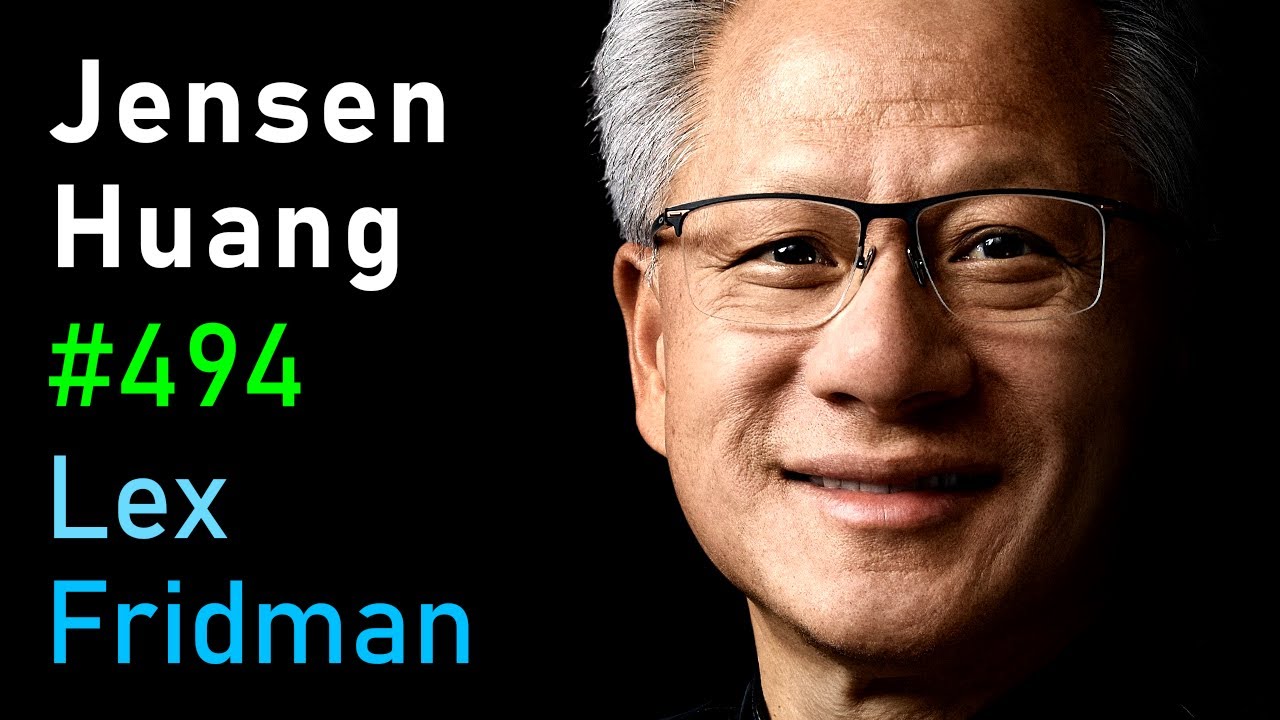
Jensen Huang begins by framing critical technology and semiconductor manufacturing as matters of national security, arguing that the United States must re-industrialize and achieve energy expansion. He explains that industrial growth and job creation rely directly on energy growth, pointing out that AI chip factories and data centers require massive power infrastructure that pro-growth energy policies must support.
Addressing public anxieties regarding artificial intelligence, Huang differentiates between human sentience and machine intelligence. He describes AI systems as software that learns from examples and acts as universal function approximators. Instead of creating unpredictable, runaway autonomous power, increasing compute scaling is primarily used to give models time to think, perform step-by-step reasoning, self-reflect, and cross-check facts to minimize hallucinations.
Huang dispels the notion that AI will cause mass technological unemployment, pointing to the Jevons paradox in healthcare: when Geoff Hinton predicted AI would eliminate radiologists, AI instead dramatically increased imaging productivity, making diagnostic tests cheaper and cleaner, which expanded overall demand and led to hiring more radiologists. Huang predicts that within two to three years, 90% of global knowledge will be generated synthetically by AI systems, elevating productivity across all industries.
Reflecting on technology scaling, Huang highlights that Nvidia's accelerated computing paradigm delivered a 100,000x increase in performance efficiency over a decade. Looking ahead, he anticipates small modular nuclear reactors (SMRs) will power local data centers. Huang concludes by recounting Nvidia's history—including a pivotal $5 million investment from Sega's CEO that saved the company in 1995, delivering the first DGX-1 AI supercomputer to Elon Musk and OpenAI in 2016, and why operating under the constant assumption that the company is '30 days from going out of business' remains his key to resilience.