The Lens · PowerfulJRE

Joe Rogan Experience #2422 - Jensen Huang

PowerfulJRE2 hr 28 min

The argument

Nvidia CEO Jensen Huang argues that artificial intelligence is an evolutionary advancement in accelerated computing rather than an existential threat, and that national leadership in AI depends on expanding domestic energy production, re-industrializing chip manufacturing, and maintaining constant corporate vigilance.

Essential viewing path

6 min of 2 hr 28 min · 4% of the source

0:002:28:26
Essential viewingLens momentChapter turn
  1. 01AI, Energy Policy, and National Security

    Huang argues that aggressive energy policy and power infrastructure expansion are prerequisites for domestic AI chip factories and supercomputers.

    5:406:40 · 1 min

  2. 02AI Safety, Reasoning, and the Nature of Intelligence

    Huang reframes AI safety, showing how additional compute scaling is used for reasoning and hallucination reduction rather than runaway threat.

    11:2012:20 · 1 min

  3. 03Defense Tech, Cyber Defense, and Synthetic Knowledge

    Contains Huang's timeline prediction regarding when AI synthetic data will generate the majority of global knowledge.

    37:2038:20 · 1 min

  4. 04Moore's Law, Accelerated Computing, and Nuclear Power

    Quantifies the 100,000x efficiency gains of accelerated computing, explaining why energy per calculation decreases dramatically over time.

    59:101:00:10 · 1 min

  5. 05The Origins of Deep Learning and OpenAI

    Recounts the 2012 AlexNet milestone that established GPU-driven deep neural networks as universal function approximators.

    1:03:201:04:20 · 1 min

  6. 06CEO Mindset, Fear of Failure, and Early Life

    Captures Huang's explanation of how fear of failure serves as the primary engine for long-term organizational focus and executive resilience.

    1:49:501:50:50 · 1 min

The Lens

6 moments that carry the argument

Each item is what a speaker said, paraphrased and placed in time. EchoLens records assertions; it does not adjudicate them.

ClaimJensen Huang

Pro-growth energy policies are necessary to power AI factories, chip manufacturing plants, and supercomputing infrastructure in the United States.

Why it matters — Links national AI competitiveness directly to domestic energy production and re-industrialization.

01 · 6:07High confidenceFrom the source. Not independently verified by EchoLens.
InterpretationJensen Huang

Rather than seeking autonomous runaway power, AI capability growth is primarily channeled into self-reflection, step-by-step reasoning, and fact-checking to reduce hallucinations.

Why it matters — Reframes compute scaling as a tool for safety and truthfulness rather than an uncontrollable existential threat.

02 · 11:40High confidence

You’re herethe moment this link points at

PredictionJensen Huang

Within two to three years, approximately ninety percent of the world's knowledge will be generated synthetically by artificial intelligence systems.

Why it matters — Highlights a profound shift in how information, software, and scientific data will be produced and consumed globally.

37:45 in the source
03 · 37:45High confidence
59:38Next key moment · Numerical statementOver a ten-year span, accelerated computing improved computing performance by one hundred thousand times, correspondingly reducing the cost and energy required per calculation.

Also on EchoLens

Numerical statementJensen Huang

Over a ten-year span, accelerated computing improved computing performance by one hundred thousand times, correspondingly reducing the cost and energy required per calculation.

Why it matters — Demonstrates that architectural and software efficiency gains vastly outpace traditional Moore's Law silicon scaling.

04 · 59:38High confidenceFrom the source. Not independently verified by EchoLens.
ClaimJensen Huang

In 2012, researchers Geoff Hinton, Ilya Sutskever, and Alex Krizhevsky created AlexNet using two Nvidia GTX 580 GPUs, proving that GPUs could scale deep neural networks into universal function approximators.

Why it matters — Pinpoints the historical turning point that transformed Nvidia from a graphics card maker into an AI computing infrastructure leader.

05 · 1:03:45High confidenceFrom the source. Not independently verified by EchoLens.
OpinionJensen Huang

The fear of failure is a far more powerful driver of corporate success and leadership resilience than ambition or the desire for success.

Why it matters — Reveals the core psychological motivation and operational mindset that guided Nvidia through multiple near-bankruptcies to market dominance.

06 · 1:50:18High confidence

Summary

In an wide-ranging conversation on the Joe Rogan Experience, Nvidia CEO Jensen Huang demystifies artificial intelligence, explaining how compute scaling turns neural networks into universal function approximators. Huang discusses the energy demands of AI data centers, the necessity of pro-growth domestic energy policies, and why AI will expand rather than eliminate human workforce opportunities. He also recounts Nvidia's dramatic history—from near-bankruptcy in 1995 to delivering the first AI supercomputer to OpenAI in 2016—and shares how a persistent fear of failure drives his executive leadership.

Read the full analysis

Jensen Huang begins by framing critical technology and semiconductor manufacturing as matters of national security, arguing that the United States must re-industrialize and achieve energy expansion. He explains that industrial growth and job creation rely directly on energy growth, pointing out that AI chip factories and data centers require massive power infrastructure that pro-growth energy policies must support.

Addressing public anxieties regarding artificial intelligence, Huang differentiates between human sentience and machine intelligence. He describes AI systems as software that learns from examples and acts as universal function approximators. Instead of creating unpredictable, runaway autonomous power, increasing compute scaling is primarily used to give models time to think, perform step-by-step reasoning, self-reflect, and cross-check facts to minimize hallucinations.

Huang dispels the notion that AI will cause mass technological unemployment, pointing to the Jevons paradox in healthcare: when Geoff Hinton predicted AI would eliminate radiologists, AI instead dramatically increased imaging productivity, making diagnostic tests cheaper and cleaner, which expanded overall demand and led to hiring more radiologists. Huang predicts that within two to three years, 90% of global knowledge will be generated synthetically by AI systems, elevating productivity across all industries.

Reflecting on technology scaling, Huang highlights that Nvidia's accelerated computing paradigm delivered a 100,000x increase in performance efficiency over a decade. Looking ahead, he anticipates small modular nuclear reactors (SMRs) will power local data centers. Huang concludes by recounting Nvidia's history—including a pivotal $5 million investment from Sega's CEO that saved the company in 1995, delivering the first DGX-1 AI supercomputer to Elon Musk and OpenAI in 2016, and why operating under the constant assumption that the company is '30 days from going out of business' remains his key to resilience.
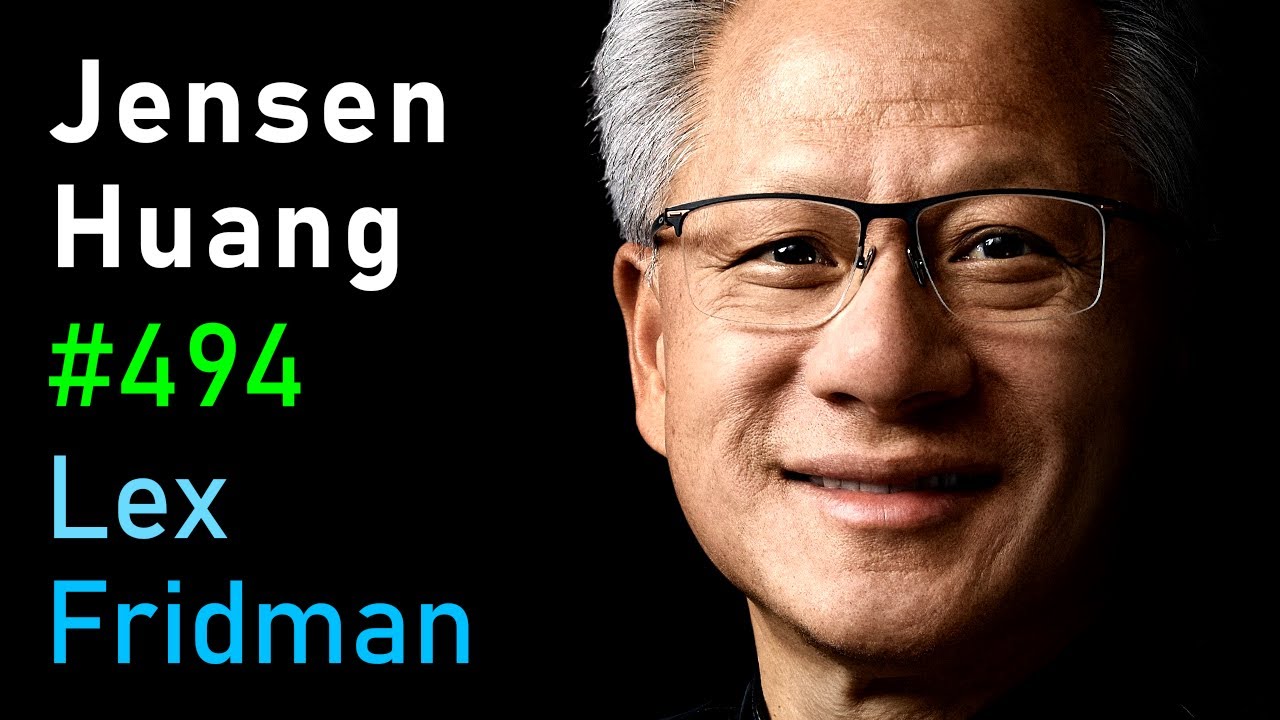
Chapters

  1. AI, Energy Policy, and National Security

    Joe Rogan and Jensen Huang discuss domestic manufacturing, national security, and why pro-growth energy policy is required to power American AI infrastructure.

  2. AI Safety, Reasoning, and the Nature of Intelligence

    Huang addresses public fears of runaway AI, explaining how scaling compute power is directed toward step-by-step reasoning, error correction, and reducing hallucinations.

  3. Defense Tech, Cyber Defense, and Synthetic Knowledge

    The discussion covers AI applications in defense, open cybersecurity models, and Huang's prediction that synthetic data will produce most future knowledge.

  4. The Jevons Paradox of AI and Job Automation

    Huang refutes claims of widespread AI job displacement, demonstrating how AI tools increase productivity and demand, creating net job growth.

  5. Moore's Law, Accelerated Computing, and Nuclear Power

    Huang explains how accelerated computing achieved 100,000x efficiency gains and envisions small modular reactors powering localized data centers.

  6. The Origins of Deep Learning and OpenAI

    Huang details the 2012 AlexNet breakthrough on Nvidia GPUs and the delivery of the first AI supercomputer (DGX-1) to OpenAI in 2016.

  7. Near-Bankruptcy, Sega, and the Pivot to RIVA 128

    Huang shares the story of Nvidia's near-failure in 1995 and how a critical partnership with Sega's CEO allowed the startup to pivot and survive.

  8. CEO Mindset, Fear of Failure, and Early Life

    Huang reflects on his management philosophy driven by fear of failure, his childhood at a Kentucky boarding school, and his belief in the American Dream.

Referenced in the source

3 of these appear in other Lenses — follow a name to see where.

Jensen HuangPerson2 Lenses
Co-founder and CEO of Nvidia who explains AI computing architecture, energy needs, and his leadership journey.
NVIDIACompany4 Lenses
Semiconductor and computing hardware company that pioneered GPUs and accelerated computing for AI.
TSMCCompany3 Lenses
Taiwanese semiconductor foundry that serves as Nvidia's primary chip manufacturing partner.
Joe RoganPerson
Host of the podcast who interviews Jensen Huang on technology, policy, and AI societal impacts.
Geoff HintonPerson
Pioneering AI researcher whose lab developed AlexNet using Nvidia GPUs in 2012.
Elon MuskPerson
CEO of Tesla and SpaceX who accepted the first Nvidia DGX-1 AI supercomputer on behalf of OpenAI in 2016.
SegaCompany
Japanese gaming company whose CEO provided a crucial $5 million contract release and investment that saved Nvidia in 1995.
Was this Lens useful?
Report this content
Analyzed
analyzed August 26, 2026
Timestamps
timestamps validated
About this analysis
Model
gemini-3.6-flash
Media resolution
resolution low
Contract
prompt 1.1 / schema 1.1

Point EchoLens at something else

Paste another public YouTube link and get the same treatment: the argument, the claims, and the moments that matter.

Analyze another source

Continue exploring

Browse all Lenses →
  • Source length 24:04

    More on AI & TechnologyMoconomy

    The Godmother of AI Reveals What Comes Next

    Recommendation19:05

    AI policy conversations must be grounded in scientific facts rather than science-fiction scenarios about human extinction or AGI overminds.

    Fei-Fei Li5 min of 24 minAug 20, 2026