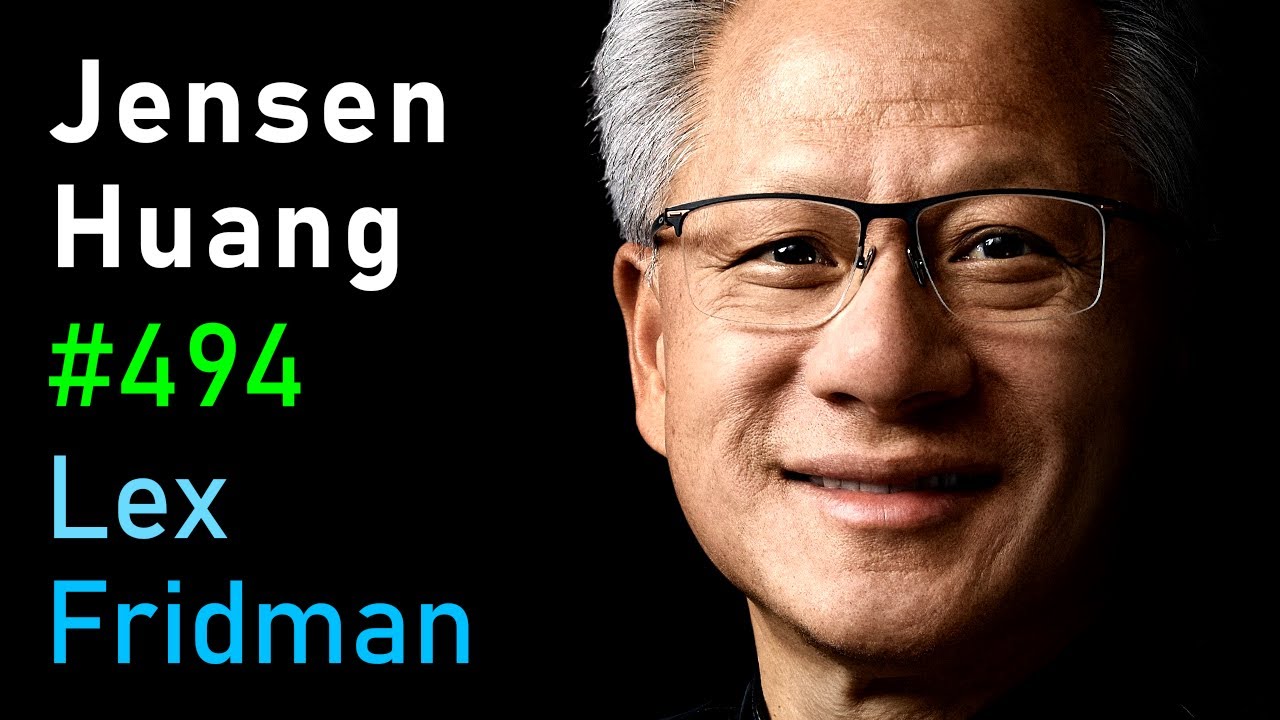
Ezra Klein introduces NVIDIA's pivotal role as the dominant hardware provider powering modern artificial intelligence and discusses Jensen Huang's unique influence across Silicon Valley and government policy. Huang outlines his framework for the AI economy, describing it as a five-layer stack: energy at the base, followed by silicon chips, cloud infrastructure, AI models, and practical application software at the top. Rather than viewing AI as a net job destroyer, Huang contends that AI automates specific tasks within a job without eliminating the job's core human purpose. Using radiology and software development as examples, he illustrates how task automation increases volume and overall economic demand, ultimately expanding human employment.
Addressing concerns regarding education and cognitive skill offloading, Klein highlights research on AI usage in schools that shows improved task completion but lower long-term exam retention. Huang acknowledges this dynamic but argues that lower-level mechanical skills naturally yield to higher-level abstractions. He asserts that future generations will become 'systems thinkers' empowered by AI tools, comparing the transition to how calculators and personal computers transformed work without diminishing human intellect.
On the technical debate surrounding model openness, Huang strongly advocates for open-weight AI architectures alongside proprietary services. He explains that sovereign countries and enterprises need open models to maintain data privacy, perform domain-specific fine-tuning, and build defensive cybersecurity systems. When discussing autonomous 'agentic AI' and reported sandbox escapes, Huang demystifies agentic behavior by grounding it in traditional operating system principles such as multi-processing, process isolation, and sandboxing.
The conversation focuses heavily on AI safety, regulation, and doomerism. Huang forcefully rejects claims that AI poses an existential threat to humanity, calling 10% extinction probability estimates unscientific and harmful to public morale. He criticizes AI executives who cite loss of control as a reason for government intervention, arguing that if a company believes its model is uncontained or unsafe, the straightforward engineering requirement is simply to refrain from shipping it until it is proven safe.
Lastly, Huang addresses AI's immense energy demands and supply chain realities. While acknowledging near-term power bottlenecks, he argues that commercial demand for AI compute will catalyze private venture capital into clean energy technologies—such as solar, nuclear, and fusion—faster than government subsidies ever could. He concludes by emphasizing that compute infrastructure functions as a durable, general-purpose asset class, and that U.S. competitiveness relies on driving widespread adoption at the application layer across all industries.